Validating Admission Policy 101
Hi!
In this article, we’ll have a look at the ValidatingAdmissionPolicy object, how it works, and some example usages.
After playing with the Pod Security Standard and the Pod Security Admission, it felt logical to continue with this, and broaden our view of some of the guardrail options that are natively available in Kubernetes.
Our agenda will be as follow:
- What is Validating Admission Policy
- Creating basic
VAP - Looking a bit deeper into the
VAPobject
1. What is Validating Admission Policy
ValidatingAdmissionPolicy, or VAP for lazy people is GA since kubernetes 1.30.
It aims to provide a native feature for validating admission webhooks.
And webhook in Kubernetes are… 🤔
I’ll make a parallele with Azure policies, which I’m more familiar with.
In Azure, you start with a Policy definition. You define policy definition so that it will allow to audit, or deny, or even change parameters on Azure objects. An example could be that we want to audit for the existance of tags, or that an Azure storage should be configured with TLS1.2. Once the definition is written, a policy assignment, on a specific scope, management group, a subscription, or even a resource group, allows to control that what we defined in the policy is check against the scope set by the assignment.
Some policies (and more and more with time) are called built-in, meaning we only need to consume those with assignment. The definition is in the Cloud provider responsibility scope.
Those built-in policies could be compared to the Pod Security Standard, for the definition, and the Pod Security Admission, for the assignment. Except that it’s a bit less rich in kubernetes than in Azure.
Now sometimes, we need to define custom policy on Azure. So we write a specific definition doing something, and we assign on the desired scope. And that’s where we have the equivalent with the VAP. The ValidatingAdmissionPolicy is the custom policy for which we define the control.
The definition of the policy in the VAP is relying on the Common Expression Language, on which more information are available on the dedicated google github repo.
In terms of concepts, as for many others kubernetes objects, we started by creating an object tat define something, in this case the VAP, and we bind this object with a related binding object, in this case the ValidatingAdmissionPolicyBinding object.
To conclude our parallele with Azure Policies, we could say that the ValidatingAdmissionPolicyBinding is kind of the Policy assignment. We should add that the VAP is only audit or deny, no modification.
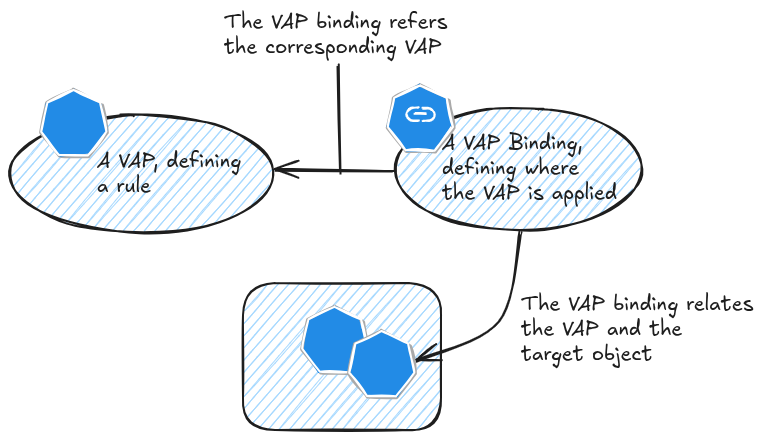
Let’s note the reference API for these objects. We’ll check that a bit later ^^. For now let’s give it a try.
2. Creating basic VAPs
There are some sample on the kubernetes documentation, but that would be no fun, so we’ll start our own VAP from scratch.
Capitalizing from our previous article about PSA, we would like to have a VAP that will check if a namespace is configured wxith the proper labels to enable the desired profile.
Basic stuff first. So we can check how to select the desired resources, in our case, namespaces. We can also check on which actions we want to trigger this policy, which would be at least at creation, and probably at update.
Those parameters are specified in a spec section:
spec
  matchConstraints:
    resourceRules:
    - apiGroups: [""]
      apiVersions: ["v1"]
      operations: ["CREATE","UPDATE"]
      resources: ["namespaces"]
Now the less easy part, we need to write the rule that will evaluate this.
As already mentioned, it relies on the CEL language.
First we would like to evaluate the existance of the labels. For this, we can try the has macro.
So something like this:
has("object.metadata.labels")
Checking the presence of a specific label should be possible with in
"pod-security.kubernetes.io/enforce" in object.metadata.labels
It seems a bit theoretical, but fortunately, we can leverage the CEL playground to validate our expression.
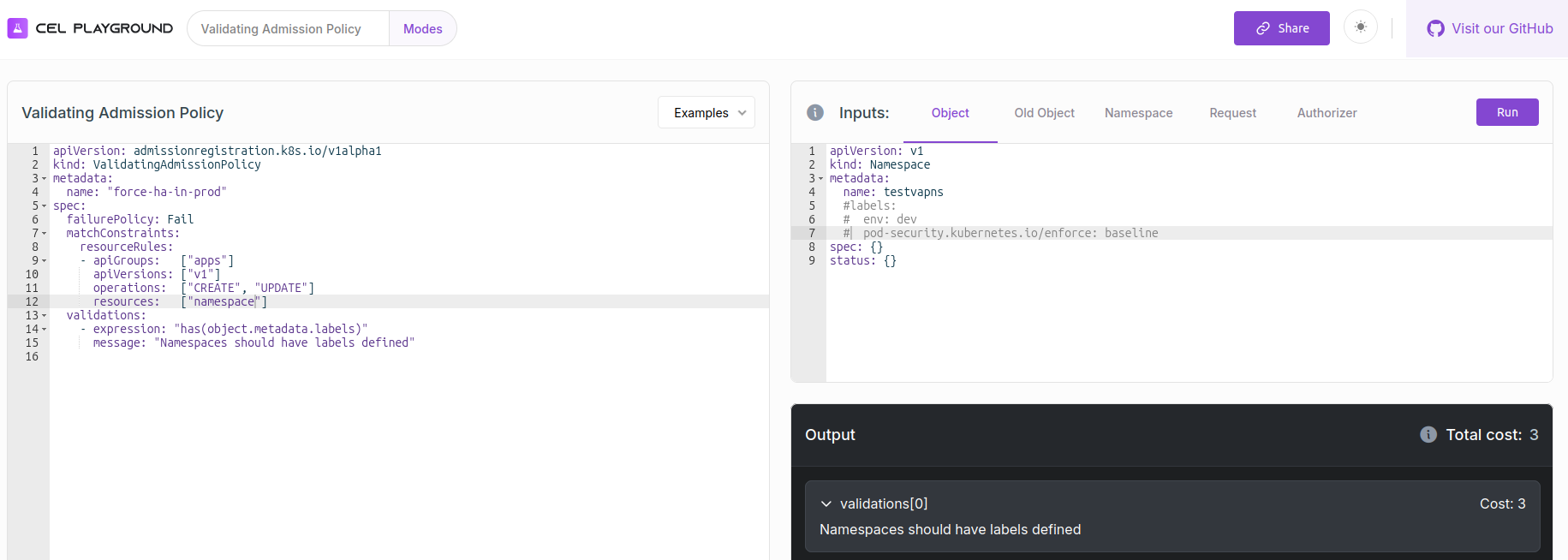
At this point, I’m capable enough only to evaluate individual expressions. However, at the end, we want to have a VAP that look like this, with all of our expressions tested individually on the CEL playground.
apiVersion: admissionregistration.k8s.io/v1
kind: ValidatingAdmissionPolicy
metadata:
  name: require-pod-security-label
spec:
  failurePolicy: Fail
  matchConstraints:
    resourceRules:
    - apiGroups:   [""]
      apiVersions: ["v1"]
      operations:  ["CREATE", "UPDATE"]
      resources:   ["namespaces"]
  validations:
    - expression: >
        has(object.metadata.labels)
        && "pod-security.kubernetes.io/enforce" in object.metadata.labels
        && object.metadata.labels["pod-security.kubernetes.io/enforce"] in ["restricted", "baseline"]
      message: "Namespaces should have label 'pod-security.kubernetes.io/enforce' defined (ex: pod-security.kubernetes.io/enforce: baseline)."
      reason: Invalid
that’s however not enough to make this work, we also need a binding. At this point, it’s a very simple binding.
apiVersion: admissionregistration.k8s.io/v1
kind: ValidatingAdmissionPolicyBinding
metadata:
  name: require-pod-security-label-binding
spec:
  policyName: require-pod-security-label
  validationActions: [Audit, Warn]
The interesting parameters in the spec section are the spec.policyName, effectively doing the binding to the VAP, and the spec.validationActions which allows us to specify what the policy will do.
After applying those manifests, we can try to create a simple namespace, without any label.
df@df-2404lts:~/kubeadm-single-cilium$ k  get validatingadmissionpolicy
NAME                         VALIDATIONS   PARAMKIND   AGE
require-pod-security-label   1             <unset>     37h
df@df-2404lts:~/kubeadm-single-cilium$ k  get validatingadmissionpolicybindings.admissionregistration.k8s.io
NAME                                 POLICYNAME                   PARAMREF   AGE
require-pod-security-label-binding   require-pod-security-label   <unset>    37h
df@df-2404lts:~/kubeadm-single-cilium$ k create ns testnsvap --dry-run=server
Warning: Validation failed for ValidatingAdmissionPolicy 'require-pod-security-label' with binding 'require-pod-security-label-binding': Namespaces should have a label 'pod-security.kubernetes.io/enforce' defined (ex: pod-security.kubernetes.io/enforce: baseline).
namespace/testnsvap created (server dry run)
We’re using the --dry-run=server to get the warning message, and be sure that we’ll not create the namespace, because at this point the policy is configured in warn and audit.
Without the --dry-run switch, we still get the warning, but the namespace is created. We can check the audit logs to validate the audit parameter of the policy.
vagrant@cilium2:~$ sudo cat /var/log/kubernetes-audit.log | jq . | grep validation -A2
    "validation.policy.admission.k8s.io/validation_failure": "[{\"message\":\"Namespaces should have a label 'pod-security.kubernetes.io/enforce' defined (ex: pod-security.kubernetes.io/enforce: baseline).\",\"policy\":\"require-pod-security-label\",\"binding\":\"require-pod-security-label-binding\",\"expressionIndex\":0,\"validationActions\":[\"Audit\",\"Warn\"]}]"
  }
}
--
    "validation.policy.admission.k8s.io/validation_failure": "[{\"message\":\"Namespaces should have a label 'pod-security.kubernetes.io/enforce' defined (ex: pod-security.kubernetes.io/enforce: baseline).\",\"policy\":\"require-pod-security-label\",\"binding\":\"require-pod-security-label-binding\",\"expressionIndex\":0,\"validationActions\":[\"Audit\",\"Warn\"]}]"
  }
}
That’s enough for some basics. Let’s go deeper now.
3. Looking a bit deeper into the VAP related objects
We saw that we manage our custom policies with the VAP and the VAP Binding.
We mention earlier the API references for those 2 objects.
We can also summarize what we wrote in terms of expression.
| Objectives | Expression CEL |
|---|---|
Check that the metada.labels section exists |
has(object.metadata.labels) |
| Check that a specific key is present in the labels | “key” in object.metadata.labels |
| Validate that the value of a key is in a list of allowed value | object.metadata.labels[“key”] in [“value1”, “value2”] |
Ok, we can now move further in our use cases.
3.1. Managing scopes
The validatingadissionpolicies and validatingadmissionpolicybindings are both cluster-wide resources,, which kind of make sense.
df@df-2404lts:~/kubeadm-single-cilium$ k  api-resources | grep validatingadmission
NAME                                SHORTNAMES                          APIVERSION                           NAMESPACED   KIND
validatingadmissionpolicies                                             admissionregistration.k8s.io/v1      false        ValidatingAdmissionPolicy
validatingadmissionpolicybindings                                       admissionregistration.k8s.io/v1      false        ValidatingAdmissionPolicyBinding
But we may want to scope the policies a bit, specifically, we would like to avoid applying the policy on some namespaces. Otherwise, since the current policy act on both CREATE and UPDATE action, trying to add label on the kube-system namespace would result to a warning.
df@df-2404lts:~/kubeadm-single-cilium$ k  label namespaces kube-system env=prd --dry-run=server
Warning: Validation failed for ValidatingAdmissionPolicy 'require-pod-security-label' with binding 'require-pod-security-label-binding': Namespaces should have a label 'pod-security.kubernetes.io/enforce' defined (ex: pod-security.kubernetes.io/enforce: baseline).
namespace/kube-system labeled (server dry run)
Looking into the API reference for the VAP, we can find the spec.matchConstraint.excludeResourceRules which includes similar arguments to the spec.matchConstraint.ResourceRules (except that… we can use it for excluding stuffs)
- apiGroups
- apiVersions
- operations
- resources
It allows us to modify our VAP as below, to exclude kube-system, kube-public and kube-node-lease namespaces
apiVersion: admissionregistration.k8s.io/v1
kind: ValidatingAdmissionPolicy
metadata:
  name: require-pod-security-label
spec:
  failurePolicy: Fail
  matchConstraints:
    resourceRules:
    - apiGroups:   [""]
      apiVersions: ["v1"]
      operations:  ["CREATE", "UPDATE"]
      resources:   ["namespaces"]
    ### Added
    excludeResourceRules:
    - apiGroups: [""]
      apiVersions: ["v1"]
      operations: ["*"]
      resources: ["namespaces"]
      resourceNames: ["kube-system", "kube-public", "kube-node-lease"]
    ###
  validations:
    - expression: >
        has(object.metadata.labels)
        && "pod-security.kubernetes.io/enforce" in object.metadata.labels
        && object.metadata.labels["pod-security.kubernetes.io/enforce"] in ["restricted", "baseline"]
      message: "Namespaces should have a label 'pod-security.kubernetes.io/enforce' defined (ex: pod-security.kubernetes.io/enforce: baseline)."
      reason: Invalid
After applying the modification, the policy is still in effect, but does not include the excluded namespaces.
df@df-2404lts:~$ k apply -f ./vapnspsa.yaml
validatingadmissionpolicy.admissionregistration.k8s.io/require-pod-security-label configured
validatingadmissionpolicybinding.admissionregistration.k8s.io/require-pod-security-label-binding unchanged
df@df-2404lts:~$ k  label namespaces default somelabel=somevalue
The namespaces "default" is invalid: : ValidatingAdmissionPolicy 'require-pod-security-label' with binding 'require-pod-security-label-binding' denied request: Namespaces should have a label 'pod-security.kubernetes.io/enforce' defined (ex: pod-security.kubernetes.io/enforce: baseline).
df@df-2404lts:~$ k  label namespaces kube-system somelabel=somevalue --dry-run=server
namespace/kube-system labeled (server dry run)
We mentioned that spec.matchConstraint.excludeResourceRules and spec.matchConstraint.ResourceRules share similar argument, so it’s also possible to target only specific resources by name:
spec:
  matchConstraints:
    resourceRules:
    - apiGroups:   [""]
      apiVersions: ["v1"]
      operations:  ["CREATE", "UPDATE"]
      resources:   ["namespaces"]
      resourceNames: ["somenamespace"]
This may not be the ideal for a broad scope policy scenario.
Let’s try other custom scope scenarios.
First we’ll create 2 new namespaces.
apiVersion: v1
kind: Namespace
metadata:
  name: testvapns-dev
  labels:
    env: dev
    pod-security.kubernetes.io/enforce: baseline
    pod-security.kubernetes.io/audit: restricted
    pod-security.kubernetes.io/warn: restricted
    pod-security.kubernetes.io/enforce-version: v1.35
    pod-security.kubernetes.io/audit-version: v1.35
    pod-security.kubernetes.io/warn-version: v1.35
spec: {}
status: {}
---
apiVersion: v1
kind: Namespace
metadata:
  name: testvapns-prd
  labels:
    env: prd
    pod-security.kubernetes.io/enforce: baseline
    pod-security.kubernetes.io/enforce-version: v1.35
    pod-security.kubernetes.io/audit: restricted
    pod-security.kubernetes.io/audit-version: v1.35
    pod-security.kubernetes.io/warn-version: v1.35
    pod-security.kubernetes.io/warn: restricted
spec: {}
status: {}
This time, we may want to ensure that pods deployed in namespace testvapns-dev have the label env with the value dev.
It would be easy to create a VAP scoped on the target namespace, but then the policy would not check condition on the pods but rather on the namespace.
Instead, we’ll start with a policy scoped on pods.
apiVersion: admissionregistration.k8s.io/v1
kind: ValidatingAdmissionPolicy
metadata:
  name: require-pod-env-label
spec:
  failurePolicy: Fail
  matchConstraints:
    resourceRules:
    - apiGroups:   [""]
      apiVersions: ["v1"]
      operations:  ["CREATE", "UPDATE"]
      resources:   ["pods"]
  validations:
    - expression: >
        has(object.metadata.labels)
        && "env" in object.metadata.labels
        && object.metadata.labels["env"] == "dev"
      message: "Pods should have a label 'env' defined (ex: env: prd)."
      reason: Invalid
To select a namespace by its name, we’ll rely on the spec.matchConstraints.namespaceSelector and make our VAP match the label kubernetes.io/metadata.name=testvapns-dev that allows us to identify the namespace by its name.
    namespaceSelector:
      matchLabels:
        kubernetes.io/metadata.name: testvapns-dev
A pod created in the testvapns-dev namespace would trigger the following message. Ignore the warning about PSA and focus on the message related to the VAP.
df@df-2404lts:~$ k  run testpodlabel --image nginx -n testvapns-dev --dry-run=server
Warning: would violate PodSecurity "restricted:v1.35": allowPrivilegeEscalation != false (container "testpodlabel" must set securityContext.allowPrivilegeEscalation=false), unrestricted capabilities (container "testpodlabel" must set securityContext.capabilities.drop=["ALL"]), runAsNonRoot != true (pod or container "testpodlabel" must set securityContext.runAsNonRoot=true), seccompProfile (pod or container "testpodlabel" must set securityContext.seccompProfile.type to "RuntimeDefault" or "Localhost")

The pods "testpodlabel" is invalid: : ValidatingAdmissionPolicy 'require-pod-env-label' with binding 'require-pod-env-label-binding' denied request: Pods should have a label 'env' defined (ex: env: prd).
For now, we rely mainly on the VAP, and the binding does not bring much to the table.
Let’s step back a little. Instead of validating a label env with a specific value, we’ll write the rule so that it checks the existance of the env label only. And to associate this VAP to different namespace, we’ll differentiate the bindings.
apiVersion: admissionregistration.k8s.io/v1
kind: ValidatingAdmissionPolicy
metadata:
  name: require-pod-env-label
spec:
  failurePolicy: Fail
  matchConstraints:
    resourceRules:
    - apiGroups:   [""]
      apiVersions: ["v1"]
      operations:  ["CREATE", "UPDATE"]
      resources:   ["pods"]
    ### Removed
    #namespaceSelector:
    #  matchLabels:
    #    #env: dev
    #    kubernetes.io/metadata.name: testvapns-dev
  validations:
    - expression: >
        has(object.metadata.labels)
        && "env" in object.metadata.labels
#        && object.metadata.labels["env"] == "dev"
      message: "Pods should have a label 'env' defined (ex: env: prd)."
      reason: Invalid
---
apiVersion: admissionregistration.k8s.io/v1
kind: ValidatingAdmissionPolicyBinding
metadata:
  name: require-pod-env-dev-label-binding
spec:
  policyName: require-pod-env-label
  validationActions: [Audit, Deny]
  matchResources:
    namespaceSelector:
      matchLabels:
        env: dev
        #kubernetes.io/metadata.name: testvapns-dev
---
apiVersion: admissionregistration.k8s.io/v1
kind: ValidatingAdmissionPolicyBinding
metadata:
  name: require-pod-env-prd-label-binding
spec:
  policyName: require-pod-env-label
  validationActions: [Audit, Deny]
  matchResources:
    namespaceSelector:
      matchLabels:
        env: prd
        #kubernetes.io/metadata.name: testvapns-prd
Trying to create pods without the label env should fail.
df@df-2404lts:~$ k  run prdpod -n testvapns-prd --image=nginx
The pods "prdpod" is invalid: : ValidatingAdmissionPolicy 'require-pod-env-label' with binding 'require-pod-env-prd-label-binding' denied request: Pods should have a label 'env' defined (ex: env: prd).

df@df-2404lts:~$ k  run devpod -n testvapns-dev --image=nginx
The pods "devpod" is invalid: : ValidatingAdmissionPolicy 'require-pod-env-label' with binding 'require-pod-env-dev-label-binding' denied request: Pods should have a label 'env' defined (ex: env: prd).
However, if the label env is added, it should work.
df@df-2404lts:~$ k  run devpod -n testvapns-dev --image=nginx --labels env=dev
pod/devpod created
df@df-2404lts:~$ k get pod -n testvapns-dev --show-labels
NAME     READY   STATUS    RESTARTS   AGE     LABELS
devpod   1/1     Running   0          3m54s   env=dev
We can easilty change the policy so that it check that the pods have either env=dev or env=prd by changing the rule like this.
  validations:
    - expression: >
        has(object.metadata.labels)
        && "env" in object.metadata.labels
        && object.metadata.labels["env"] in ["dev", "prd"]
      message: "Pods should have a label 'env' defined (ex: env: prd)."
      reason: Invalid
However, at this point, we cannot ensure that the pod has the same env value as its namespace.
Also, the message are not very specific. Checking that into the log does not help much to find where the impacted workload is located.
3.2. Be more dynamic in the VAP
So, we want to be more dynamic on our expressions, for the rules, or for the messages that come with the rules.
For that, we can have a look at the Validation Expression documenation.
Up until now, we used object to target the object impacted by the VAP.
For example, has(object.metadata.labels) check that the object looked in the VAP (namespace or pod) has labels.
We can also leverage namespaceObject. This would allow us to write the expression has(namespaceObject.metadata.labels) that checks the namespace of the object evaluated in the expression, and evaluate its labels.
Note that if the VAP was evaluating a cluster-wide resource, the namespaceObject would return null, and thus our previous expression would always be false.
Ok let’s write our new VAP.
apiVersion: admissionregistration.k8s.io/v1
kind: ValidatingAdmissionPolicy
metadata:
  name: require-pod-env-label
spec:
  failurePolicy: Fail
  matchConstraints:
    resourceRules:
    - apiGroups:   [""]
      apiVersions: ["v1"]
      operations:  ["CREATE", "UPDATE"]
      resources:   ["pods"]
  validations:
    - expression: >
        has(object.metadata.labels) &&
        "env" in object.metadata.labels &&
        has(namespaceObject.metadata.labels) &&
        "env" in namespaceObject.metadata.labels &&
        object.metadata.labels["env"] == namespaceObject.metadata.labels["env"] &&
        namespaceObject.metadata.labels["env"] in ["dev", "prd"]
      messageExpression: >
        'Pod "' + object.metadata.name +
        '" in namespace "' + namespaceObject.metadata.name +
        '" should have a label "env" corresponding to the namespace. ' +
        'Expected value: ' + namespaceObject.metadata.labels["env"] +
        '. Current value of the Pod: ' +
        (has(object.metadata.labels) && "env" in object.metadata.labels ?
         object.metadata.labels["env"] : 'not defined')
      reason: Invalid
In the expression section:
has(object.metadata.labels)checks that the pod has labels- “env” in
object.metadata.labelschecks that the label env is defined has(namespaceObject.metadata.labels)checks that the namespace of the pod has labels- “env” in
namespaceObject.metadata.labelschecks that the namespace of the pod has the label env object.metadata.labels["env"]==namespaceObject.metadata.labels["env"]checks the corresponding value between env labels on namespacve and pod.
Noticed also in the messageExpression section:
- ‘Pod ‘ +
object.metadata.namewill translate to Pod pod_name - ’ in namespace ‘ +
namespaceObject.metadata.namewill translate to in namespace namespace_name - …
You got the point… 😏
Let’s try this.
df@df-2404lts:~$ k run devtest --image nginx -n testvapns-dev --dry-run=server
The pods "devtest" is invalid: : ValidatingAdmissionPolicy 'require-pod-env-label' with binding 'require-pod-env-dev-label-binding' denied request: Pod "devtest" in namespace "testvapns-dev" should have a label "env" corresponding to the namespace. Expected value: dev. Current value of the Pod: not defined
df@df-2404lts:~$ k run devtest --image nginx -n testvapns-dev --labels env=prd --dry-run=server
The pods "devtest" is invalid: : ValidatingAdmissionPolicy 'require-pod-env-label' with binding 'require-pod-env-dev-label-binding' denied request: Pod "devtest" in namespace "testvapns-dev" should have a label "env" corresponding to the namespace. Expected value: dev. Current value of the Pod: prd
df@df-2404lts:~$ k run devtest --image nginx -n testvapns-dev --labels env=dev --dry-run=server
Warning: would violate PodSecurity "restricted:v1.35": allowPrivilegeEscalation != false (container "devtest" must set securityContext.
pod/devtest created (server dry run)
df@df-2404lts:~$ k run devtest --image nginx -n testvapns-prd --labels env=dev --dry-run=server
The pods "devtest" is invalid: : ValidatingAdmissionPolicy 'require-pod-env-label' with binding 'require-pod-env-prd-label-binding' denied request: Pod "devtest" in namespace "testvapns-prd" should have a label "env" corresponding to the namespace. Expected value: prd. Current value of the Pod: dev
It works as expected. If the pod does not have the label env, it’s blocked. If it has the env label but with a value different than the one in the namespace, it’s also blocked.
Last thing, we will probably not create pods outside of deployments or other controllers. If we try to create a deployment (and thus some pods), we’ll get no message at the deployment creation, but the pods will not be scheduled.
Checking the replicaset status, or the namespace events will, give us the error message related to the VAP.
df@df-2404lts:~$ k create deployment testdeploydev --image=nginx --replicas 3 --namespace testvapns-dev
Warning: would violate PodSecurity "restricted:v1.35": allowPrivilegeEscalation != false (container "nginx" must set securityContext.allowPrivilegeEscalation=false), unrestricted capabilities (container "nginx" must set securityContext.capabilities.drop=["ALL"]), runAsNonRoot != true (pod or container "nginx" must set securityContext.runAsNonRoot=true), seccompProfile (pod or container "nginx" must set securityContext.seccompProfile.type to "RuntimeDefault" or "Localhost")
deployment.apps/testdeploydev created
df@df-2404lts:~$ k get deployments.apps -n
cilium-secrets   default          kube-node-lease  kube-public      kube-system      testnsvap        testvapns-dev    testvapns-prd
df@df-2404lts:~$ k get deployments.apps -n testvapns-dev
NAME            READY   UP-TO-DATE   AVAILABLE   AGE
testdeploydev   0/3     0            0           28s
df@df-2404lts:~$ k get replicasets.apps -n testvapns-dev testdeploydev-7d9d99cd69 -o json | jq .status.conditions
[
  {
    "lastTransitionTime": "2026-04-27T10:22:30Z",
    "message": "pods \"testdeploydev-7d9d99cd69-grgdp\" is forbidden: ValidatingAdmissionPolicy 'require-pod-env-label' with binding 'require-pod-env-dev-label-binding' denied request: Pod \"testdeploydev-7d9d99cd69-grgdp\" in namespace \"testvapns-dev\" should have a label \"env\" corresponding to the namespace. Expected value: dev. Current value of the Pod: not defined",
    "reason": "FailedCreate",
    "status": "True",
    "type": "ReplicaFailure"
  }
]
df@df-2404lts:~$ k events -n testvapns-dev
LAST SEEN   TYPE      REASON         OBJECT                                MESSAGE
50m         Warning   FailedCreate   ReplicaSet/testdeploydev-7d9d99cd69   Error creating: pods "testdeploydev-7d9d99cd69-l9rqh" is forbidden: ValidatingAdmissionPolicy 'require-pod-env-label' with binding 'require-pod-env-dev-label-binding' denied request: Pod "testdeploydev-7d9d99cd69-l9rqh" in namespace "testvapns-dev" should have a label "env" corresponding to the namespace. Expected value: dev. Current value of the Pod: not defined
33m         Warning   FailedCreate   ReplicaSet/testdeploydev-7d9d99cd69   Error creating: pods "testdeploydev-7d9d99cd69-zgsxq" is forbidden: ValidatingAdmissionPolicy 'require-pod-env-label' with binding 'require-pod-env-dev-label-binding' denied request: Pod "testdeploydev-7d9d99cd69-zgsxq" in namespace "testvapns-dev" should have a label "env" corresponding to the namespace. Expected value: dev. Current value of the Pod: not defined
17m         Warning   FailedCreate   ReplicaSet/testdeploydev-7d9d99cd69   Error creating: pods "testdeploydev-7d9d99cd69-xnvf9" is forbidden: ValidatingAdmissionPolicy 'require-pod-env-label' with binding 'require-pod-env-dev-label-binding' denied request: Pod "testdeploydev-7d9d99cd69-xnvf9" in namespace "testvapns-dev" should have a label "env" corresponding to the namespace. Expected value: dev. Current value of the Pod: not defined
39s         Warning   FailedCreate   ReplicaSet/testdeploydev-7d9d99cd69   Error creating: pods "testdeploydev-7d9d99cd69-2vqbb" is forbidden: ValidatingAdmissionPolicy 'require-pod-env-label' with binding 'require-pod-env-dev-label-binding' denied request: Pod "testdeploydev-7d9d99cd69-2vqbb" in namespace "testvapns-dev" should have a label "env" corresponding to the namespace. Expected value: dev. Current value of the Pod: not defined
3.3. Using paramKind
If we check the VAP, we can see that we have the PARAMKIND column showing <unset> for our 2 samples.
That’s because to this point, we have not used the paramKind argument. As the documentation states, this parameter allow a policy configuration to be separate from its definition.
We can illustrate this with the following configMap:
apiVersion: v1
kind: ConfigMap
metadata:
  name: psaparameters
  namespace: default
data:
  #
  allowedPSSVersion: "v1.34, v1.35"
  allowedPSSLevel: "restricted, baseline"
With this, we create another VAP from the previous one. We’ll notice the paramKind section pointing to a configMap.
apiVersion: admissionregistration.k8s.io/v1
kind: ValidatingAdmissionPolicy
metadata:
  name: restrict-psa-with-params
spec:
  failurePolicy: Fail
  paramKind:
    apiVersion: v1
    kind: ConfigMap
  matchConstraints:
    resourceRules:
    - apiGroups: [""]
      apiVersions: ["v1"]
      operations: ["CREATE", "UPDATE"]
      resources: ["namespaces"]
    excludeResourceRules:
    - apiGroups: [""]
      apiVersions: ["v1"]
      operations: ["*"]
      resources: ["namespaces"]
      resourceNames: ["kube-system", "kube-public", "kube-node-lease"]
  validations:
  - expression: >
      has(object.metadata.labels) &&
      "pod-security.kubernetes.io/enforce" in object.metadata.labels &&
      object.metadata.labels["pod-security.kubernetes.io/enforce"] in params.data.allowedPSSLevel.split(",")
    messageExpression: >
      'Operation ' + request.operation + ' on Namespace "' + object.metadata.name +
      '" failed: the label "pod-security.kubernetes.io/enforce" must have a value among: ' +
      params.data.allowedPSSLevel + '. Current value: ' +
      (has(object.metadata.labels) && "pod-security.kubernetes.io/enforce" in object.metadata.labels ?
       object.metadata.labels["pod-security.kubernetes.io/enforce"] : 'undefined')
    reason: Invalid
Last we define the binding, in which we point to the configMap created earlier. We can notice this time the parameterNotFoundAction, set to Deny, that states how the VAP react if the configMap is not there. In this case, it means that the policy denies if it cannot found the parameters specified for the paramKind section.
apiVersion: admissionregistration.k8s.io/v1
kind: ValidatingAdmissionPolicyBinding
metadata:
  name: restrict-pss-version-with-params-binding
spec:
  policyName: restrict-psa-with-params
  validationActions: ["Audit","Deny"]
  paramRef:
    name: psaparameters
    namespace: default
    parameterNotFoundAction: Deny
Once everything is created, if we try to create a namespace without the proper labels, it’s blocked as expected.
df@df-2404lts:~$ k create ns testns
The namespaces "testns" is invalid: : ValidatingAdmissionPolicy 'restrict-psa-with-params' with binding 'restrict-pss-version-with-params-binding' denied request: Operation CREATE on Namespace "testns" failed: the label "pod-security.kubernetes.io/enforce" must have a value among: restricted, baseline. Current value: undefined
If the configMap is not present, for any reason, we get another deny, but the message is quite clear about the reason why.
df@df-2404lts:~$ k create ns testns
The namespaces "testns" is invalid: : ValidatingAdmissionPolicy 'restrict-psa-with-params' with binding 'restrict-pss-version-with-params-binding' denied request: failed to configure binding: no params found for policy binding with `Deny` parameterNotFoundAction
Reflecting on the use of paramKind and paramRef, what could we use it for?
Typuically, in the PSS/PSA configuration, we could imagine the configMap as the repository of the required paramters for those.
allowedPSSVersion would allow us to maintain the version of the PSS on a single point rather than on all the poilicy that may use it.
We could also use the configMap to specify the level of pod-security.kubernetes.io/enforce required, depending on the environment, and so on for the pod-security.kubernetes.io/audit labels.
There is more to this than what we will do in this single article 😎.
For now, let’s wrap it
4. Summary
While in the previous article, we had a look at the built-in policies for Kubernetes by the mean of Pod Security Standard/Admission, this time, we looked at more custom stuff with the ValidatingAdmissionPolicy.
That requires understanding the associated language (CEL) and how we should work between the VAP and the VAP Binding.
We also had a look at some way to make it flexible, in the expression, or in the parameters, with the CEL specificities for the former, and the paramKind/paramRef for the latter. About the PramKind, it’s interesting to note that while we used configMap, it’s also possible to use CRDs, that should be defined obviously. I would say that it is useful to manage cluster-wide resources nstead of namespaced ones such as the configMap.
In our Kubernetes policies journey, we are now at the place of knowing how to to custom policy to deny or audit, but still no automated remediation.
We’ll talk about that next time ^^